
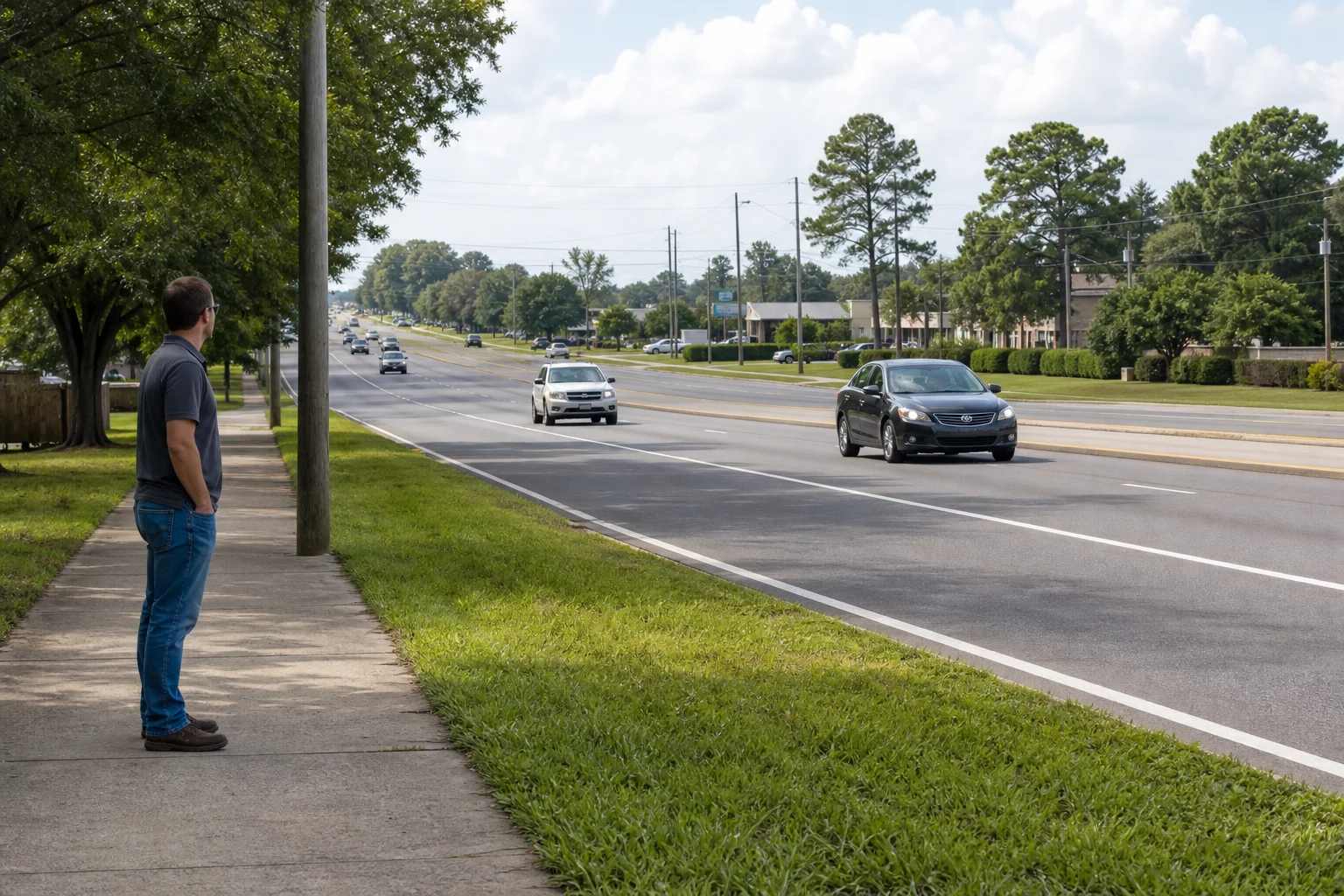
A Three-Part Test for Unmarked Crossings
-
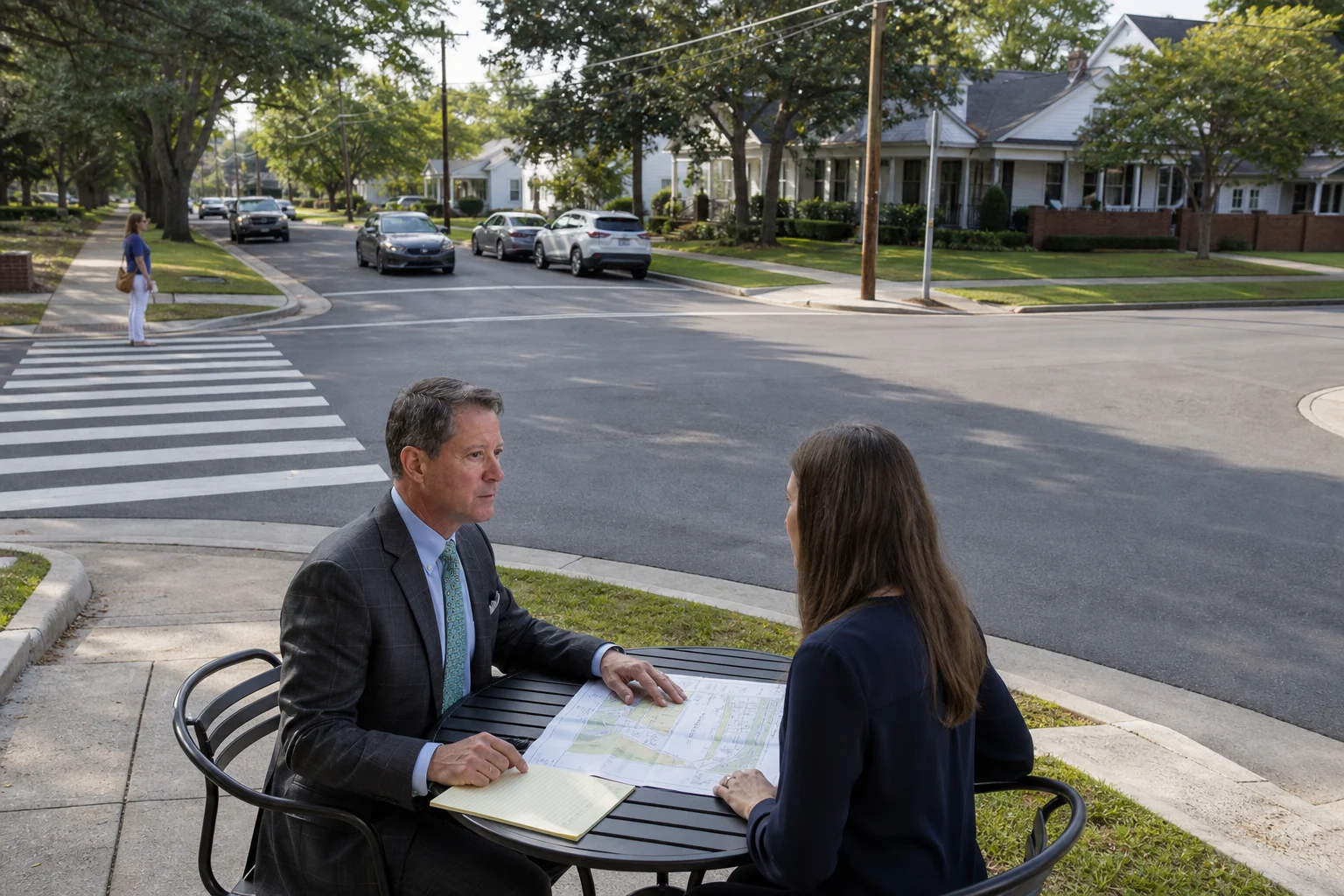
Determine Whether the Location Is an Intersection
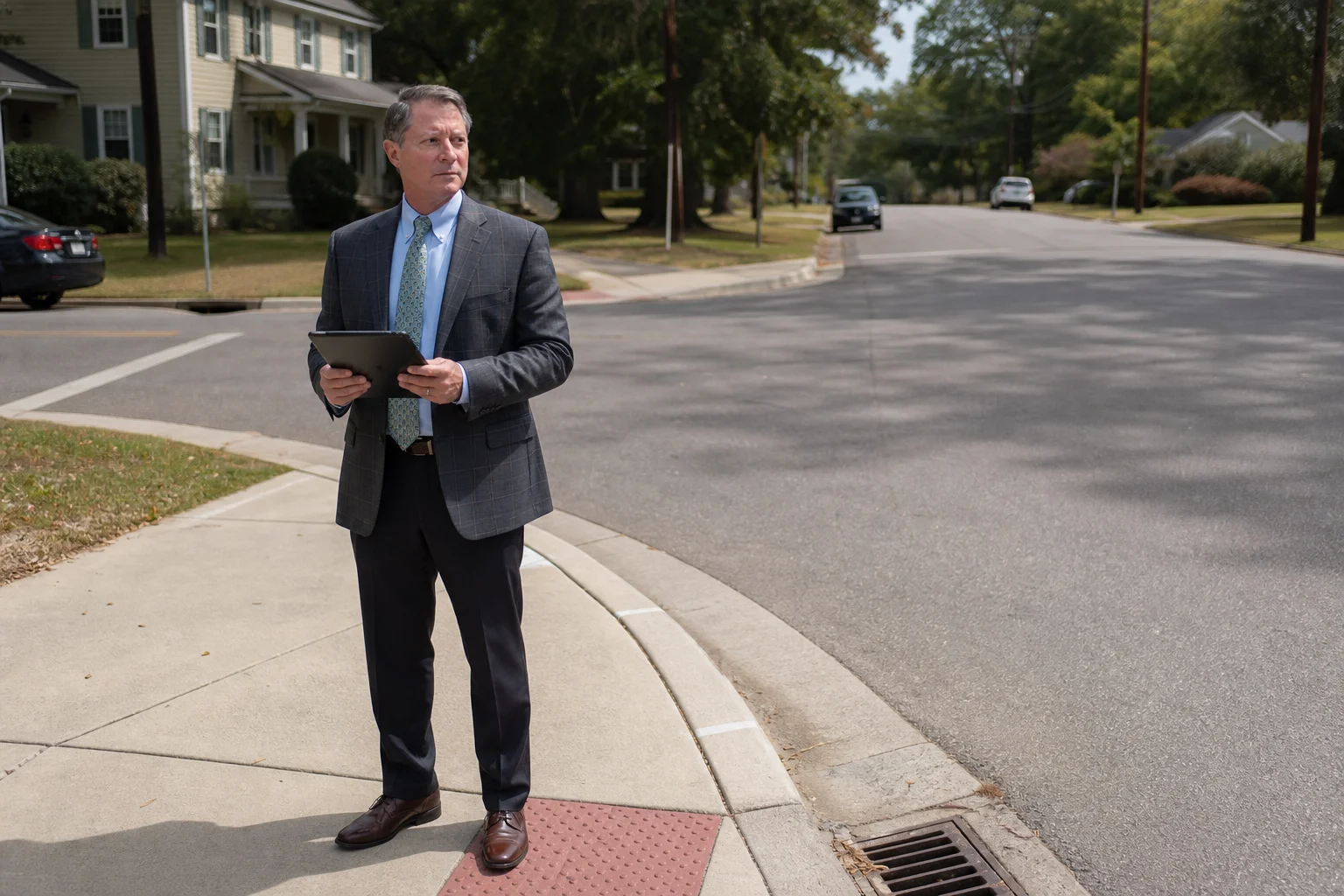
Do not decide this question from the paint alone. The intersecting streets, sidewalk alignments, median configuration, and overall roadway geometry may affect whether the crossing point falls within the statutory definition.
-
Locate the Pedestrian Relative to the Crosswalk
Determine whether the person was inside a painted crosswalk, within a legally recognized unmarked crosswalk at an intersection, or crossing somewhere else.
-
Check the Signals, Timing, and Immediate Hazard
Traffic signals can control movement. When signals are absent or not operating, the pedestrian’s position in the roadway and the proximity of approaching vehicles become important.
How the Crossing Location Changes the Yield Rule
| Crossing Location | How It Is Treated | Basic Yield Rule |
|---|---|---|
Marked crosswalk |
A roadway area distinctly indicated for pedestrian crossing by lines or other markings. |
If signals are absent or not operating, a driver must yield when the pedestrian is on the driver’s half of the roadway or approaching it closely enough to be in danger. |
Unmarked crosswalk at an intersection |
The statutory definition can include the intersection area within the connections of the lateral sidewalk lines on opposite sides of the highway. |
The same no-signal yielding rule can apply even though no crosswalk lines are painted. |
Unpainted crossing outside an intersection crosswalk |
A crossing that is neither marked nor within a legally recognized unmarked crosswalk at an intersection. |
The pedestrian generally must yield to vehicles. Between adjacent signalized intersections, crossing is permitted only in a marked crosswalk. |
How Alabama Defines a Crosswalk
Alabama’s statutory definition of a crosswalk covers two basic configurations. One is the familiar roadway area marked by paint or other markings. The other is a portion of an intersection included within the connections of the lateral sidewalk lines on opposite sides of the highway.
This second part of the definition is why missing paint does not necessarily eliminate crosswalk protection. At an ordinary intersection, a crosswalk may exist as a matter of law even if no stripes are visible on the pavement.
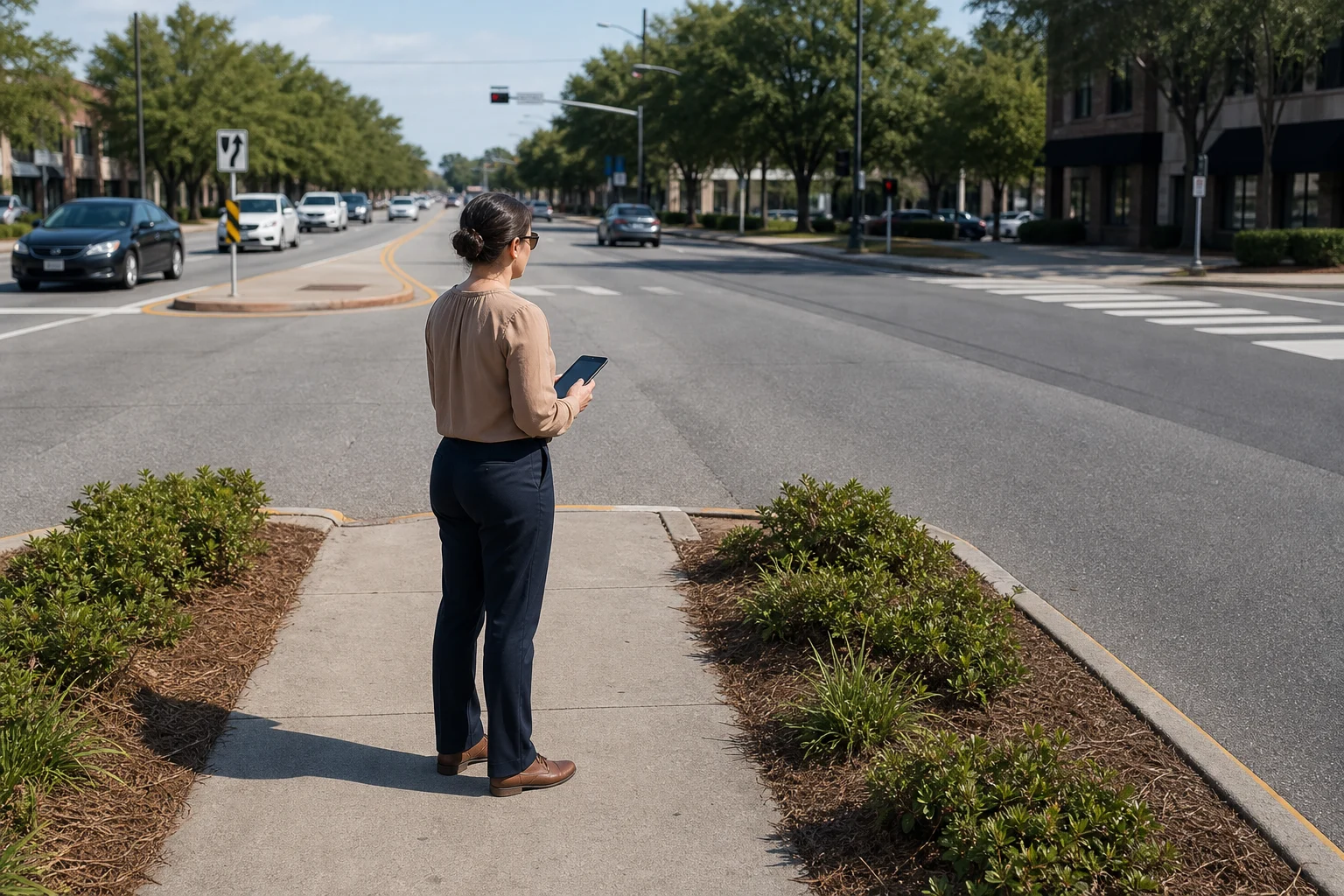
That principle should not be stretched into a claim that every unpainted crossing is automatically a crosswalk. Offset streets, T-intersections, medians, missing sidewalks, and heavily modified roadways may present harder questions. The geometry and evidence must support the conclusion that the person was within the relevant intersection area. These location questions commonly arise in intersection collision claims.
Signals and Immediate Hazards Can Change the Rule
When traffic-control signals are absent or not operating, a driver must yield to a pedestrian crossing within a crosswalk if the pedestrian is on the driver’s half of the roadway or approaching that half closely enough to be in danger. That rule applies to marked crosswalks and qualifying unmarked crosswalks at intersections.
The pedestrian’s right-of-way is not unlimited. A pedestrian may not suddenly leave a curb or another place of safety and enter the path of a vehicle that is so close that it creates an immediate hazard.
Signals add another layer. Unless a pedestrian signal says otherwise, a pedestrian facing a green signal may proceed within a marked or unmarked crosswalk. Drivers making turns on specified green signals or permissible red signals must yield to pedestrians lawfully within an adjacent crosswalk.
As a result, the legal analysis may turn on more than whether a pedestrian had started crossing. It may also depend on the signal phase, the pedestrian’s location, the vehicle’s direction of travel, and how abruptly the pedestrian entered the roadway.
Alabama Pedestrian Fatalities in Selected Years
View Data
| Label | Pedestrian fatalities |
|---|---|
| 2015 | 98 |
| 2018 | 107 |
| 2021 | 128 |
| 2022 | 112 |
| 2023 | 120 |
| 2024 | 120 |
The reported annual total was 120 pedestrian fatalities in both 2023 and 2024, after reaching 128 in 2021.
Why an Unpainted Midblock Crossing Is Different
A pedestrian crossing somewhere other than a marked crosswalk or an unmarked crosswalk at an intersection generally must yield to vehicles on the roadway. Alabama law also provides that pedestrians crossing between adjacent intersections controlled by traffic signals may cross only in a marked crosswalk.
The Alabama Supreme Court’s 2024 decision in Virgo v. Roberts illustrates why the definition of an intersection matters. The crossing occurred near a median turn lane, but no street intersected the road at that point. The court concluded that the location was not an intersection and was neither a marked crosswalk nor an unmarked crosswalk at an intersection. The pedestrian was therefore required to yield.
Virgo does not establish that every median, turn lane, or unusual roadway configuration produces the same result. It shows why a legal intersection cannot be assumed merely because a roadway feature looks like a possible crossing point. When roadway design or visibility is also disputed, the facts may overlap with issues addressed in hazardous roadway accident cases.
Driver Duties Do Not Disappear Outside a Crosswalk
A rule requiring a pedestrian to yield does not give a driver permission to ignore a person in the roadway. Alabama law separately requires every driver to exercise due care to avoid colliding with a pedestrian, sound the horn when necessary, and take proper precautions upon observing a child or an obviously confused, incapacitated, or intoxicated person.
At the same time, this duty is based on reasonable care rather than strict liability. As Virgo explains, the mere fact that a vehicle struck a pedestrian does not by itself establish driver negligence.
The inquiry instead focuses on the circumstances confronting each person. In claims involving pedestrians struck by vehicles, crosswalk status is important, but it is not necessarily the only issue affecting responsibility.
How Contributory Negligence Can Affect a Claim
Alabama’s contributory-negligence rule can completely bar recovery on an ordinary negligence claim. For an injured pedestrian, that makes compliance with crossing rules and the precise sequence of events especially important.
In Baker v. Helms, the Alabama Supreme Court held that an adult pedestrian was contributorily negligent as a matter of law after crossing outside a protected crosswalk location and emerging from behind another vehicle into the path of an approaching vehicle.
That decision does not make every outside-crosswalk collision identical. Alabama decisions also recognize subsequent negligence after a driver has actual knowledge of a pedestrian’s peril as a separate issue when supported by the evidence. Whether that doctrine or another theory applies requires a fact-specific legal analysis.
Why the Distinction Matters in Alabama
ALDOT’s 2024 Alabama Crash Facts reports that 819 pedestrians were involved in Alabama crashes during 2024, with 620 injuries and 120 fatalities. Across the report’s 2015–2024 series, annual pedestrian fatalities ranged from 98 to 128.
Those figures do not decide fault in any individual collision. They do underscore why drivers, pedestrians, investigators, and courts must look beyond the presence or absence of paint and examine the actual crossing location and surrounding circumstances.
Frequently Asked Questions
Does Missing Paint Alone Decide Whether There Is a Crosswalk?
No. Alabama’s definition includes certain intersection areas connected by lateral sidewalk lines, as well as areas marked for pedestrian crossing. At offset, T-shaped, sidewalk-free, or altered intersections, the roadway geometry and other evidence may matter.
How Do Traffic Signals Affect Pedestrian Right-of-Way in Alabama?
Signals can control the analysis. Unless a pedestrian signal directs otherwise, a pedestrian facing a green signal may proceed within a marked or unmarked crosswalk. Drivers making specified turns on green or permissible red signals must yield to pedestrians lawfully within an adjacent crosswalk.
Does a Driver Still Have Duties When a Pedestrian Is Outside a Crosswalk?
Yes. Drivers must exercise due care to avoid colliding with pedestrians and take specified precautions when necessary. That duty is one of reasonable care, however, and a collision alone does not establish negligence.
Does Crossing Outside a Crosswalk Automatically Decide an Injury Claim?
No. Alabama’s contributory-negligence rule can bar recovery on an ordinary negligence claim, but the result depends on the evidence and sequence of events. Subsequent negligence may be a separate issue when the evidence supports actual knowledge of peril.